Brenda Proulx writes about life with words from the Author of Life…
Author: Brenda Proulx
Wife, mother and grandmother, educator and someone who thinks about the things I observe. I am the daughter of a writer; my dad's career was in the field of journalism. More significantly, I am God's child, a person believing in Jesus Christ and in His timeless Word. Blogging is new to me but I feel like I've always had a pen in my hand. I jot notes in my planner, mark papers, underline verses, write many letters, and occasionally draft articles for work or church. When I am not holding a pen, I am probably cuddling a mug of coffee.
It’s an odd thing to be grateful for, waiting rooms. Specifically, waiting rooms in a doctor’s office or clinic. Though some doctors offer plush lobbies with a stack of great magazines, that’s not the ones I have in mind. I am referring to ones with sterile styling and plasticized upholstered chairs. Though there may be light chatter, more often there is a serious quietude. In these anterooms, one observes unfiltered humanity. It’s like people watching at an airport but with far more pathos. So why would I be grateful for waiting rooms? It’s not the patience factor.
Experiencing waiting rooms evokes gratitude in me first because I usually see folks who are going through so much more than me. Whatever I may be dealing with that brought me to this place, it is clear that others are suffering and facing more serious, even life-threatening illnesses. It is hard and humbling to see sick people or those going through extreme treatment.
During one wait, my husband noticed a frail, elderly woman come in alone. She checked in and was handed a clipboard of forms that appeared to overwhelm and confuse her. He asked if she wanted help, and he was able to read and write for her until she was called back for her appointment. Another time we ran into a friend of mine and her husband. We greeted each other but didn’t ask any questions; later I found out her husband had advanced cancer. I thank God for the reminder, the wakeup call, about my many blessings, including my health.
I also welcome the opportunity to witness the goodness of mankind in medical lobbies. In the waiting and watching I observe care and concern between families, between friends. I have noticed elderly sisters; husbands and wives, young and old; adult children with a parent; paid caregivers; and other companions accompanying patients. There’s so much to admire and appreciate in the compassion and sacrifice of one to another. One young woman, clearly experiencing difficult illness and treatment, came in with her uncle who lived several states away because her husband had to be out of town on business – heartwarming and heart wrenching all at once. But it is good to see goodness.
Theologians call this goodness “common grace.” It’s the capacity God gives His human creation to do good, as He Himself is good. Doing good is not to be equated with salvation however: salvation comes through faith in Jesus, God’s grace-filled gift to us. The Scriptures say, “ … He saved us, not because of works done by us in righteousness, but according to His own mercy …” Titus 3 v 5 But our disposition for goodness, despite our sinful selves, uplifts us and ultimately lifts us to acknowledge God, the provider of goodness, compassion, and salvation.
We are grateful for God’s encouraging presence during a recent medical journey.
References on gratitude: Psalm 136, 1 Thessalonians 5 v15 & v18. If you receive my blog via email, thank you. The posts are best viewed at “A Writer’s Daughter”
We recently commemorated the 80th anniversary of D Day, the Allied Forces’ rescue of France and other European countries invaded by Germany. As that heroic event was being remembered, I was reading the autobiography of a young Jewish man who lived through the Nazi occupation of Holland. His first-hand account of the persecution and eradication of Jews astounds me once again. It is a clarion wake-up call for today. As with other World War 2 fiction and nonfiction books I’ve read recently, the realities are unfathomable.
Ernest Cassutto was a Dutch university student at the time of the Nazi invasion of Holland. As the round-up of Jews in Holland intensified, Cassutto and his family went into hiding, as did his fianceé and her family. Gestapo raids kept them on the move and in constant fear. Ernest and his fiancee were eventually caught, and she was killed in a concentration camp. The Germans never deported Ernest but sent him to forced labor farms in Holland. Though the liberation of Europe began on D Day in June of 1944, the Netherlands was not freed until nearly a year later in May of 1945. Ernest and his family survived the Holocaust. The Jewish young girl he later married also survived the Holocaust. A Christian teacher in rural Holland took her in, but her parents were captured and died at the hands of Nazis.
Ernest Cassutto’s fiancee, as shown in his autobiography, was killed in Auschwitz.
What is stunning about the experiences of the Jews like Ernest Cassutto was the explicit race profiling. The Cassutto family did not practice their Judaism. In fact, due to being born overseas, Ernest was not circumcised, a fact known to his German captors. The slaughter of approximately six million people was based entirely on their identity as Jews! How terrifying to realize that this genocide happened in modern times, in ‘civilized’ culture.
At this point you’ll wonder why “A Writer’s Daughter” is addressing history!? Cassutto’s life story took an early twist. Just prior to the war, Ernest examined the Christian faith. A pastor directed him to Isaiah 53, where he and his fiancé came to believe in Jesus as the Messiah and their personal Savior. It was the Christian community who put themselves in great danger to hide and protect Jewish friends and neighbors from the Nazis. Several of Ernest’s family members and his future wife also received the Gospel as a result of the perilous resistance work by Christians for the sake of their Jewish brothers and sisters.
Ernest Cassutto recognized the clear description of a Savior suffering for the salvation of sinners in Isaiah 53. John 13 v 35 clearly conveys a deep responsibility to the saved: “By this all people will know that you are my disciples, if you have love for one another.” Many loved courageously during Hitler’s evil regime. Some lost their lives doing so.
References:
The Last Jew of Rotterdam by Ernest Cassutto. I also recommend Letter to the American Church by Eric Metaxas.
The familiar idiom ‘music to my ears’ suggests welcome news, something one is glad to hear, but in my case a theme played on repeat in my head. For the last few weeks, the topic of music circulated around me. First my mind recalled in-home concerts I experienced. Then I read about the benefits of singing in sync with others (Pink, Daniel. When. 2018). More music related hints came from a recent sermon text on singing (Ephesians 5 v 19), a link to register for the “Sing” conference, and a daily verse describing God singing over us. Finally, last week, CeCe Winan’s “(I will sing of) The Goodness of God” music video hit one of my text threads followed by it being one of the worship songs in Sunday’s service. So, on music at home and singing I will write! This composition will not win a Pulitzer, but it will stop the ringing in my ears.
Have you attended a concert in a home? Though rare these days, music in the home was common before TV, radios, stereos, and phonographs. Entertainment was homemade: music and games in the parlor. Whoever could play or sing, did so with family and for guests. There were mansion ballroom dances accompanied by chamber groups and barn dances with fiddles. Simpler days spawned simpler ways.
I experienced an extraordinary concert at my sister’s home. She, an accomplished pianist, and a musician friend on the vibraphone, gave a concert at a graduation party. They far surpassed the level of skill for most in-home recitals, but it retained the warmth of a home setting with an intimate audience. Pictured is her keyboard with music for the opening number.
Today music is piped in and turned on everywhere, like the surprisingly loud easy rock playing in pre-op before my last colonoscopy. We access any artist, any song with a flick on our phone. Our access to music is quite amazing, yet live music, even if amateur, feeds us in a different and unique way. Many years back, I recall a friend’s child played her piano recital piece for our visit. Another time a neighbor invited several of us to her home so she could play a dress rehearsal for an upcoming musical she was accompanying. On a New Year’s Day, a group of us sang “Auld Lang Syne” together as the host strummed it on his guitar. Maybe you recall a hearthside serenade, a parlor performance, or an impromptu campfire concert or sing-along – I hope so! We could all try singing a hymn at mealtime or hum the children a bedtime lullaby. I don’t discount streaming playlists at home which adds cheer or comfort too, especially when our voice joins the chorus.
Music is a gift from our Creator. We get joy from making music, music can praise Him, and God sings over us. Zephaniah 3 v 17 expresses, “The LORD thy God … will joy over thee with singing” (shared in the King James Version as it was shared with me.)
The trek through turmoil is a slow one. When mess surrounds, the mundane persists. Life unravels but the dishwasher needs to be loaded and unloaded, the car needs gas, and the trash must go out. Elisabeth Elliot, widow of one of five missionaries murdered in the Ecuadorian jungle in 1956, taught this admonition: “do the next thing.” In other words, in that spot of loss or commotion, you move forward to a task at hand, however menial, even if you don’t feel like it.
John Ortberg assigns such a holding pattern to the Saturday between the crucifixion and the Resurrection. He writes of the “silent Saturday,” when the terror and adrenaline of Friday’s nightmare were over, yet no one knew about Sunday’s coming triumph (Ortberg, 2012). The followers of Jesus could not foresee it, especially as they waited through the silent Saturday ritual day of Sabbath rest.
But they got through Saturday and got up on Sunday. With their world having fallen apart, Mary and two other women arose early, prepared spices, and went to the tomb to embalm the dead body of Jesus. It was a routine task, but they managed to get up and “do the next thing.” (As ordinary as the women’s act of ministration was, it is recorded in all four Gospels: Matthew 28 v 1, Mark 16 v 1, Luke 24 v 1, John 20 v 1.) And that’s when they discovered the miracle! The tomb was empty, angels on guard, and then their encounter with Jesus! In doing the mundane, they experienced the Divine!
In our lives, the extremes are not usually as glaring as crucifixion Friday and Resurrection Sunday. We face losses and tragedy, healing and success. In the middle life of these, we press forward in daily simple obedience to God. Though I find the encouragement to “do the next thing” very helpful, here on Easter Monday, I remind myself that every day this side of the cross is really a victory lap!
Ortberg, John. (2012) Who Is This Man? Zondervan.
Credit for this photo goes to the official Paris 2024 Olympics site.
Words intrigue me. In linguistic studies, one learns that language does not stagnate: it changes over time. Words are lost, words change, and words are rediscovered or newly created. The word ‘camera’ isn’t used much anymore since it’s our phone. ‘Google’ is a verb that was nonexistent 30 years ago. ‘Transformative’ has replaced ‘transformational’ in popularity, though their meanings may be distinct.
I recently heard a new use of a familiar word: random > randomize. ‘Randomize’ describes how researchers randomly select participants for the experiment variable or for the control group. To keep the results unbiased, the experimental assignments are made with, another new term we have – AI! Randomizing might select a traveler for additional security checks or determine the order of questions in an online exam. A patient might be told they were ‘randomized’ for a treatment in a clinical trial.
But is anything really randomized? Are our lives left to chance? I believe that God is in control of all things. Scripture tells us that God knows when a lowly sparrow falls (Matthew 10:29), that God sends elements like rain and fire, (Matthew 5 v 45, 2 Kings 1 v 10), and that He saw us forming in the womb and has numbered the days of our lifetime! (Psalm 139 v 15 – 16). God’s plans supersede the adage “right place at the right time.”
But what about “wrong place at the wrong time?” Yes, in God’s sovereignty, we face terrible things sometimes, yet we are promised God’s guidance and help when we walk the path He’s planned for us (Psalm 37 v 23 below). In other instances, one might have strayed to the wrong place and face consequences (Psalm 119 v 9, Proverbs 7 v 25).
Here, in conclusion, I admit that these are hard truths. Followers of Jesus boldly give God credit for His provision and blessings, or cling to His strength in crisis; it is a day-by-day surrender to do so, only through Holy Spirit power. AMEN
I have been mulling over a podcast I listened to last week. Following the news story of the Lakewood Church shooting in Houston, TX, “The World and Everything In It” (wng.org/podcasts) contributor John Stonestreet discussed some of the issues related to the event. Stonestreet spoke of “deaths of despair” and “acts of desperation,” terms I was not familiar with. These are increasing at “skyrocketing rates,” he said, and he rightly attributes that to the logical outcome of a secular worldview. He explains that the “expressive, individualistic secular culture (that) gives them no strong resources of a stable family, a stable sense of identity or anything else” leaves people “grasping for a cause, grasping for hope.” But Stonestreet lands the interview on hope, and it is the hope the church has to offer: “Christianity grounds (us in) dignity and value and purpose.” For the church, “this is a mission moment,” he concludes.
Here is a place I often arrive at: the unique role of the church for you and me. The Church is the God-given structure for bonding believers to Biblical truths and to each other. As we gather and grow, what we know fills our lives and the lives of others we touch. That does not mean that there will never be a searching, confused soul like the woman at Lakewood Church, but more of us will be grounded and confident in God’s design and purpose for our lives and this will have a ripple effect around us.
Each Friday, “The World and Everything In It” podcast ends with a blessing and a charge for the weekend. It is my closing today for you as well: “the Psalmist writes: “Why are you cast down, O my soul, and why are you in turmoil within me? Hope in God; for I shall again praise him, my salvation and my God.” (Psalm 43 v 5) Worship with brothers and sisters in Christ in Church this weekend, and Lord willing, we’ll meet you right back here on Monday. Go now in grace and peace.”
The extensive quotes in this blog post are all from this source:
This is the Church of St John the Baptist in Burford, England. It is not just a beautiful relic in The Cotswolds, it is a functioning church. We were touring on a Sunday and the usher asked us not to come in if we couldn’t stay for the whole worship service. A praise team with guitars were leading upbeat music and a mother had to leave the sanctuary with her fussy toddler. Real church!
He grew up in a northern US city with plenty of naturally frozen skating spots all winter, and her childhood in Canada was replete with abounding enthusiasm and opportunities for ice skating over many winter months each year. With mutual friends from church, he asked her out on their first date to go ice skating. Wasting no time for feelings to melt, he gave her a Valentines Day card shortly following the skating date. Their romance quickly swirled into an engagement on her June birthday, and they married at the end of that summer. Their honeymoon included time in Lake Placid where they skated together at the indoor Olympic rink.
My parents – beautiful bride & groom.
That first February ice skating date happened more than six decades ago. My parents continued to enjoy skating together over many of those years. They shared their love of ice skating with us kids. Virginia winters were milder than their hometowns, but we skated on rinks, and occasionally on the Washington Monument reflecting pool and the nearby C & O canal in years when they froze over. I remember buying my own full-size, good quality leather skates during a visit to family in Canada.
My parents also shared with us what it means to be married: “one man, one woman, one lifetime,” as Pastor Jeff at my church succinctly put it. Like pairs skating, marriage is magical, elegant, sensual, rhythmic, and risky – a dynamic partnership. There will also be bumps and bruises along the way. Marriage requires endurance and stamina, like the long program in skating competition. Couples can’t skate by on infatuation alone.
Marriage is God’s good and natural design for us, His creation (Genesis 2 v 24). Love is laced throughout the Scriptures. You’ll find romantic love stories and Solomon’s PG-13 passionate song in the Old Testament. Themes and analogies of weddings, the bride, and marital joy, commitment, and purity weave through the New Testament. Ultimately, we find God’s sacrificial love for us in the familiar verse John 3:16
For this is how God loved the world: He gave his one and only Son, so that everyone who believes in him will not perish but have eternal life. NLT
Thank you, Mom and Dad, for your beautiful love story. Thank you, Heavenly Father, for loving us enough to give us your Son, Jesus.
ICONIC!
If you subscribe to my posts via email, thank you. Posts are best viewed directly at the website A Writer’s Daughter
Do you remember doing book reports in elementary school? Teachers cleverly devised multiple project ideas to ensure that students were regularly reading books. Assignments included paragraph summaries on 3 X 5 cards, dioramas, posters, book jackets, and others you may recall. Book reading for the young student continues to be a high priority at the elementary level, but approaches have changed, which I will not get into here. Instead, I will report on two, make that three, books I read in 2023. They stand out for me in ways I’d like to share. I hope my synopses earn passing marks from you!
“Live Not By Lies” was the famed dissenter Aleksandr Solzhenitsyn’s clarion call to resist Soviet repression, especially of religion. Writer Rod Dreher borrowed Solzhenitsyn’s phrase to entitle a book he never intended to write. Live Not By Lies lays out a “soft totalitarianism” that is creeping, maybe steamrolling, into American culture. Dreher came to author the book when immigrants from communist countries approached him about the glaring similarities of events and policies in Western democracies to the oppression in communist countries that they had personally experienced.
The book uncovers the many ways that a liberal ‘creed’ is being forced onto American society. Warning that it could happen again, Dreher recounts dreadful stories of massive religious persecution in Soviet block nations. It is a sobering and very unsettling book to read, but the story is not limited to America’s current dangerous reality and the evil history of the recent past. Dreher shares the steadfastness of individuals, families and congregations who resisted communist aggression against their faith, and he explains how their means of resistance were effective. He suggests these are ways that would be successful again.
My other book report features the book The Thrill of Orthodoxy by Trevin Wax. I saw the book on a recommended list in 2022 and was captured by its title – a bit of an oxymoron? The author was a new name to me, but I liked his bio. ‘Orthodoxy’ sounded daunting, nonetheless I bought the book and determined to read it. I was pleasantly surprised: the book was quite readable and compelling! Wax’s thesis is that orthodoxy, the timeless doctrines of the Christian faith, is adventurous and exciting. Rather than being dull or static, the Christian faith has been and always will be solid, stable, exuberant, invigorating … and in other words, thrilling! Joy and energy permeated the explanations and examples of historic Christian orthodoxy.
For extra credit, let me tell you how the two books are complementary. The onslaught of a new totalitarianism determined to wipe out Judeo Christian beliefs is chilling, but the orthodox truths of God are firm and life-giving. Scripture is “for such a time as this,” not unlike the Jewess, Queen Esther’s, vital calling during an impending genocide (Esther 4 v 14). With confidence and fortitude, we hold on to our foundational beliefs knowing they, by the power of God and His Son Jesus, will withstand the confrontations that may lie ahead.
Indeed, the Bible is the third in my book review of 2023. Now my assignment is complete and posted by the January 31 due date! As this first month of 2024 draws to a close, evaluate the quality and quantity of your Bible reading: set some goals or make a plan for the year ahead, inasmuch as “Every word of God proves true” (Proverbs 30 v 5) and “Man shall not live by bread alone, but by every word that comes from the mouth of God” (Matthew 4 v 4).
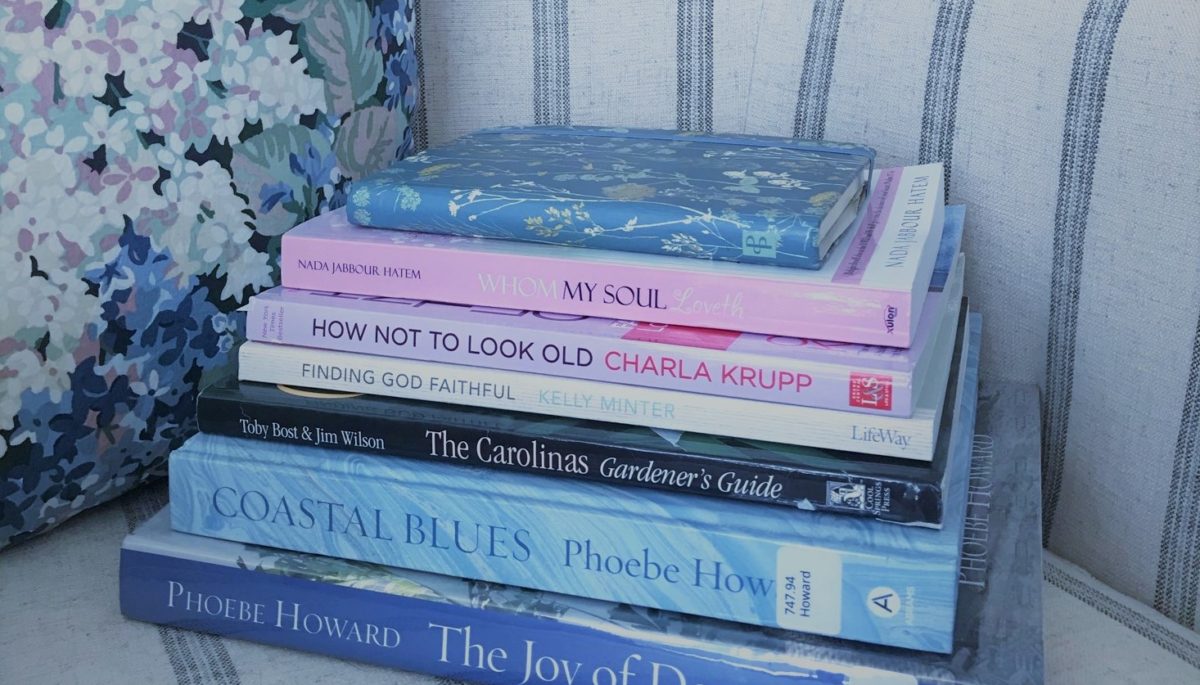
The topmost book on the pile is a journal I keep of books I read. I record the title, author and a brief summary and critique.
If you subscribe to my blog via email, thank you. My posts are best viewed directly from A Writer’s Daughter.
Today’s Sunday morning view behind our home is crispy and clear.
On a local errand this fall, I noticed several large birds perched on the roof of a house. I can often identify birds, but I wasn’t sure about these. They weren’t black enough to be vultures. They weren’t shore birds either. My guess was turkeys, but the rooftop landing seemed odd. Shortly thereafter, I came across an article on turkeys in the December issue of my favorite local publication, Wrightsville Beach magazine.
The article confirmed that turkeys live in the wild in this area. It described their social construct of small flocks and their roosting habits, as well as showing photographs that matched the color and shape of the birds I saw. And just last Sunday we saw two more flocks of turkeys grazing alongside a highway. Yes, as the piece noted, turkeys are “frequently observed” in our wooded, coastal area!
The article, “And Then There Were Some,” mostly focused on the resurgence of the turkey population in North Carolina. Apparently, wild turkeys were becoming scarce in the state in the early 20th century. Conservation efforts were made to protect and promote turkey life. These were successful and a flourishing turkey population has been restored. I enjoy hearing that native species thrive in their natural habitat and I will look forward to recognizing wild turkeys roadside and on rooftops.
Today is designated as Sanctity of Life Sunday and sadly, America’s human population is not protected and fully valued. Not every little person is promised the opportunity to thrive in our country. Instead, parents may opt to extinguish the life of their unborn baby. It’s a glaring contradiction to think that our society values the whales and the wolves and the wild turkeys yet wavers when it comes to human beings. Yes, there are rights but there are also undeniable responsibilities: to manage sexual behavior, to commit to family relationships, to honor human life. Regardless of what our laws permit or do not permit, our hearts must yearn for the dignity of all life, celebrating the creation of new life, and grieving the destruction of the same.
We are celebrating new life in our family!
Following a calamity that took all his possessions and children, the Biblical ancient, Job, rightly acknowledged the sole sovereignty of God over life and death, saying, “The Lord gave, and the Lord has taken away.” (See full context of Job 1 v 21 and also Job 12 v 10 and Job 31 v 15)
If you subscribe to my blog via email, thank you. My posts are best viewed at www.brendaproulx.com
One of my manger scenes, a mix of nativity sets. Spanish moss serves as straw. Some time I will tell you about the creche I saw in Europe.
I had ideas for a December 2023 Christmas blog, but I couldn’t carve out the time for writing that post last month. Today, Epiphany, also called Three Kings’ Day and Little Christmas, as the church calendar commemorates the Magi’s visit to Jesus, presenting their gifts of gold, frankincense, and myrrh to Him, I present two Jesus stories. The first is one I wrote last year, when my blog was down due to a major hacking. I added secondly, another Jesus story I posted in December 2021. May you enjoy these gifts from me, that I hope remind you of the great story of Jesus our Savior.
“Presenting a Baby Jesus” – 2022
He was born a sickly baby. For whatever reason, his parents left him in the care of hospital social workers; his physical condition would require intense medical treatment for the foreseeable future. Yet he survived infancy and continued in the care of hospital staff. He grew, although he was not nurtured, and therefore did not make the baby milestones of sitting, walking, and talking. Eventually the toddler, still facing serious medical challenges, needed a home and guardians. Social services reached out to a couple who had experience with adoption and fostering, and who also had medical expertise. The couple prayerfully considered the situation: it was not a plan they had in mind, but is it ever? They agreed to become his temporary guardians.
In the following months, the little guy required highly specialized medical intervention. His foster parents procured doctors who could address his complex needs. At one point, it required weeks of living out of state with him for surgery, hospital convalescence and follow-up. His medical outcome was good, and he began to gain childhood developments, even though his long-term prognosis and life-expectancy were uncertain.
Eventually, social services approached the couple about permanent adoption. Again, after prayerful consideration, the couple decided not to adopt the little boy. Their own children were grown, and they felt the child needed a young family. At this point, one of the couple’s grown children, who had been adopted herself, asked to adopt the little boy. She had been around him often as her parents had fostered him and she felt called to be his mother. Miraculously, the social agency processed the bureaucratic red tape successfully, and the young woman became his mother. The child now has a home and he is part of a big family whom he has known since his earliest memory.
Nativity cutout ornaments from a friend; hung on a very bright day!
I got to meet this sweet little guy and his family last Christmas. He is full of love and life. As he and his mother left the gathering, he went around the table one by one, giving each of us a good-bye hug. And what is his name? Jesus. Can you believe he shares the name of our Savior, whose birth we celebrate at Christmas!? It is Christ’s birth, life and resurrection that allows us to be adopted into God’s family, becoming sons and daughters of His promises. I can’t word it any better than Galatians 4 v 4a and 5b: “But when the fullness of time had come, God sent forth His Son … that we might receive adoption as sons.”
Two beautiful “Jesus” stories. Amen.
“A Real Life Mary and Joseph Story”- 2021
Friends of ours, Darrell and Cindy*, own a rental property. It’s not hobby real estate; the income it generates represents an important component of their finances. Keeping the unit rented with reliable tenants is a priority. During one rental turnover, Darrell and Cindy were interviewing interested renters. There were several good prospects including some newlyweds who were acquaintances of the previous renters.
The young couple toured the unit and liked it but felt it was beyond their budget. They told Darrell and Cindy that they were expecting a baby and wanted to get a place on their own, but their income was limited. They also shared that their baby was diagnosed with a medical condition, likely resulting in additional expenses. Doctors were not optimistic.
Darrell and Cindy looked at other good applicants for the rental, but the growing little family stayed on their minds. They decided to pray about it and consider how a discounted rent would impact their income. Darrell admitted that turning the couple away seemed like telling Mary and Joseph there was no room in the inn! They came back to the couple and asked what rent amount would work for them. An agreement was reached, and they signed a lease. What a sweet miracle for the young couple in an exciting but uncertain time.
Darrell and Cindy prepped the unit and finalized the paperwork. Darrell spoke to the previous renters about returning their deposit. They were a bit surprised to find out about the money, since even as a budget-conscious couple, they had not realized the deposit was still due them. Aware of the situation of the new renters, they told Darrell to keep their security deposit and apply it as the new security deposit! Another unexpected little miracle! The new couple moved in, and their baby boy was born. He is healthy and growing with no immediate health issues, such a great miracle for his young parents.
This nativity is on display at the Museum of the Bible in Washington, DC.
Darrell and Cindy demonstrate how Christ followers live close to truths of the Bible. Being sensitive to known needs around us and meeting them in practical ways within our capacity is what Jesus told us to do (in many passages such as Luke 3:11). And as Darrell and Cindy would tell you, the blessing is all yours.
At Christmastime, we see the stable scene creches and sing of the lowly manger birth. On the night of Jesus’ birth, no rooms were available in Bethlehem, forcing Mary and Joseph to lodge outside. Later in His ministry Jesus charged, “you have no room for my word” (John 8:37). It is worth asking: have you left Jesus out in the cold, or do you make room for Him in your heart and daily life? The best miracle is that He is at the door, knocking and asking to come in (Revelation 3:20).
*names are changed to maintain anonymity
One Christmas, Cindy gave me this book, a found treasure, if you know what I mean. She didn’t know that I had long admired the creche collection at The Metropolitan Museum of Art. Although I visited New York city many times at Christmas, I never made it to the Nativity tree exhibit.
If you subscribe to my blog, and receive posts via email, thank you. Posts are best viewed directly at the blog site, www.brendaproulx.com